

Oysters
“But Christ could certainly not have established the Church. That is, the institution we now call by that name, for nothing resembling our present conception of the Church—with its sacraments, its hierarchy, and especially its claim to infallibility—is to be found in Christ’s words”
—Leo Tolstoy
“Jesus was not crucified for saying we should love one another. He was crucified for saying that the religious authorities were corrupt, that the temple was compromised, and that the kingdom of God was breaking in to upend the whole system.”
—Dominic Crossan, historian and former Catholic priest
“You might think I’ve come to bring peace to the earth, but I haven’t. I’ve come to cut a dividing line with a sword. Because of me, sons will turn against their fathers, daughters will turn against their mothers, daughters-in-law will turn against their mothers-in-law. Enemies will come from people’s own households.”
—From Matthew 10:34-36
Abnormal.
Divergent.
Odd.
Peculiar.
Unnatural.
Actually, quite strange.
These terms might seem irreverent in describing Jesus, but he was not typical—not by any stretch of the imagination.
Maybe, in thinking we’re so familiar with the story, we miss the details. The fact is, Jesus proved to be more than a little different.
What else do you say about a guy who traveled from town to town with 12 men, several women, and a band of adoring acolytes, speaking to whoever would listen—in synagogues, marketplaces, out in the streets and open fields; just about anywhere there were people, Jesus would deliver his challenge to the status quo.
He had no formal job, he was just out talking to people. And, the stuff he said could be a little bit…odd:
- “I’ll tear down the temple and rebuild it in three days.” The original temple took about 100 years to build. Jesus basically said, “Give me a weekend and a hammer.”
- “Eat my flesh, drink my blood…” the disciples probably looked at each other like, “Is this metaphorical or should we be concerned?”
- “Hate your mother and father…” Disciples: “Cool, cool, cool… Should we tell our moms now or wait until after dinner?”
- “Sell everything you have and give away the money.” This isn’t the way prosperity preachers get you to invest a “faith seed gift” for their new jet.
All of this could be described:
- charitably as: (A) extreme
- less charitably: (B) mentally unwell.
The Trilemma
In the mid-nineteenth century, a Scottish preacher named John Duncan formulated what he called the “trilemma.” Jesus was either a fraud, deluded, or divine. Watchmen Nee and C.S. Lewis later expanded on the trilemma. Josh McDowell added alliteration to the trilemma. Jesus was either a lunatic, a liar, or he was Lord.
Based on the things Jesus did, his contemporaries could be forgiven for assigning some instances with description “A” and some with “B.” Even his own mother and brothers thought maybe he had lost it and came to bring him home on at least one occasion.
However, it is more than the crazy stuff he said. His actions seemed strange too.
How about drawing in the sand as a (probably) naked woman—caught during an illegal sex act—is in front of you waiting to be sentenced to death? Odd behavior, yep.
How about spitting in the dirt and rubbing the mud in somebody’s eyes to help them see again? “Over the top and sensationalistic” might be the description.
What about crafting a whip, screaming like a madman, and physically threatening the money exchangers in the temple because he didn’t like their exchange rates? A pretty extreme reaction.
Strange behavior? Of course.
The same Jesus of the thoughtful, contemplative paintings of the renaissance art of 16th century Europe, is also the guy who cast demons into pigs, killed a fig tree to make a point, and claimed a dead girl was only sleeping.
Even his advance man was unconventional.
The people must have known Jesus to be a different kind of teacher from the lifestyle of his goodwill ambassador—John “the Baptist.” John lived a strange lifestyle. He didn’t speak in churches; his pulpit was a muddy river and his congregation consisted of those on the shore. He spent his time making some people mad and dunking the ones he won over underwater in a commitment ritual. He wore wild animal skins for clothes. His main diet consisted of bugs and honey (he apparently couldn’t be bothered to take time for a proper meal). When he became so popular that the Jewish puppet king came out to see him, he accused the king in front of everyone of having an illegal sex life. (Herod would later have John executed at the request of a young dancer.)
This was Jesus’ advance man. When this is the type of guy you send as your publicist, you know there’s going to be trouble, and there was. To the established powers, Jesus was nothing short of an insurrectionist.
The Great Divider
Jesus became one of those public figures people either loved or hated. Some people were ready to die for him, others wanted him dead—in the end, there was no real middle ground.
It’s amazing when people talk about Jesus as a great teacher. If you examine his teachings as a whole, they were disruptive and problematic. Unless he was who he claimed to be.
Both Christians and non-Christians alike try to sanitize Jesus. We clean up his image. People like to say Jesus was all about love and acceptance, but he made people mad enough to carry out his murder.
It wasn’t just the establishment either. People today talk about Jesus as if he were some hippie songwriter from the 1960s, penning tomes about flower power and free love without consequence. Nothing could be further from the truth. Jesus was an agitator, a troublemaker, a divisive figure to most.
Those on the bottom rungs of society loved him, but those with power, prestige, or privilege hated him. Eventually, when he didn’t meet the expectations of the proletariat, they called for his execution too. Jesus failed to conform to the expectations of the aristocracy and the revolutionaries. Both those who had power at the top, and those on the bottom who wanted it, shared a problem with Jesus.
Jesus never wanted to be popular; he wanted change.
Jesus didn’t try to change how people saw him; he tried to change how people saw the world.
Jesus didn’t try to make God more presentable; he presented a “take it or leave it” message about God.
He would say things which were hard to understand, or difficult to take if you did understand him, and say, “to the one who has ears, let him hear”—a favorite of his sayings. He didn’t try to get the messaging right. He talked right and wrong. He didn’t believe people held their own truth; he said he was the truth.
When political parties lose an election they always say they didn’t get their message out. Jesus got his message out and they murdered him for it.
The truth is that Jesus stands as the great divider. He drew a line in the sand and dared people to cross it. With him there was no ‘sort of’ or ‘maybe.’ With Jesus it was, “say ‘yes’ when you mean ‘yes’ and ‘no’ when you mean ‘no.’”2F2F[1] End of story.
He said, “You might think I’ve come to bring peace to the earth, but I haven’t. I’ve come to cut a dividing line.” 3F3F[2]
We love to grind the edges off Jesus. We sand the edgy parts down and we smooth them out. We make him a little less scratchy. But Jesus remains edgy. There is a reason why they killed him.
Pearls of Wisdom
Oysters are amazing creatures. They have the ability to produce and grow their own shell from leftover minerals in their diet. Their shell is made of a pearlescent substance called nacre. When irritated by a piece of sand or other irritant, they begin secreting nacre, and, over time, an oyster turns a jagged, scratchy, foreign object into potential jewelry—this is where pearls come from. At the heart of every natural pearl is a piece of sand or other sharp object which caused injury to a mollusk. It takes time and commitment, but the oyster takes something that causes pain, irritation, or injury and turns it into an incredibly smooth, perfectly round little orb that it can live with.
Organized religion is a little like an oyster. Jesus said and did some things not measuring up to “respectable” society. If we’re being honest, irreligious and nonreligious are not okay with the real message of Jesus either; they just enact the privilege of dismissing the parts they don’t like as fable.
Jesus may not have been as polite as he could have, so we pretend otherwise. He told us to take a beating with pacifism and we rationalize it away. He didn’t always explain himself to the spiritually dull, so we do the job for Him. He offered and demanded total forgiveness, but we qualify both because of the level of difficulty required. Organized religion does its best to smooth over the uncomfortable parts about the life and message of Jesus.
For the rest of the world outside the church, they are even less knowledgeable about the authentic Jesus than Christians. In a time of plastic statues, crucifixion jewelry, and people thanking Jesus for everything from scoring a touchdown to winning a Grammy for best gangsta-rap album, the world also seems to have lost something about who Jesus was and is. He is not your homeboy. He is an irritant to everyone who likes things smooth.
But Jesus’ edginess is not what makes him so compelling; it’s the cause of the edginess which makes him captivating. It’s his:
- Uncompromising commitment to love and comfort the unloved and the broken
- Unconditional acceptance of the unacceptable
- Disdain for pointless rules or ritual and undying dedication to meaningful action
- Lack of respect for formality and
- Uncool willingness to wear his heart on his sleeve.
It has been my privilege to speak in hundreds of churches over the last few decades, but when traveling and speaking at churches I often wonder to myself “Would Jesus make it as the pastor of this church?” I don’t think Jesus would last long in the pulpits of most of the churches I’ve seen.
It’s in his resume:
- An unmarried thirty-something who didn’t care about buildings or facilities
- Someone who attended parties where people drank and ate too much and who was himself accused of being a drunk and glutton
- A teacher who seldom explained what he was talking about
- Someone who once told religious leaders that the town whore would become famous for the beautiful way in which she treated him4F4F[3]
It’s hard to see how a preacher would be accepted by most Christian congregations if he acted like Christ did.
All this makes me wonder if we’re missing something. I wonder if Christianity and Christ are incongruous mathematical sets. I wonder if the algebraic inequality of Christianity and Christ results from a lack of solving properly for X. I wonder if frustrated chalk boards of religion over 2000 years of trying to make the math work for the faithful have rounded down who Jesus really was—and is.
If we have lost something, there’s a simple reason why. Maybe we’re more like oysters than we think. It’s the nature of being human. But I implore you, don’t act like a mollusk. You aren’t an oyster.
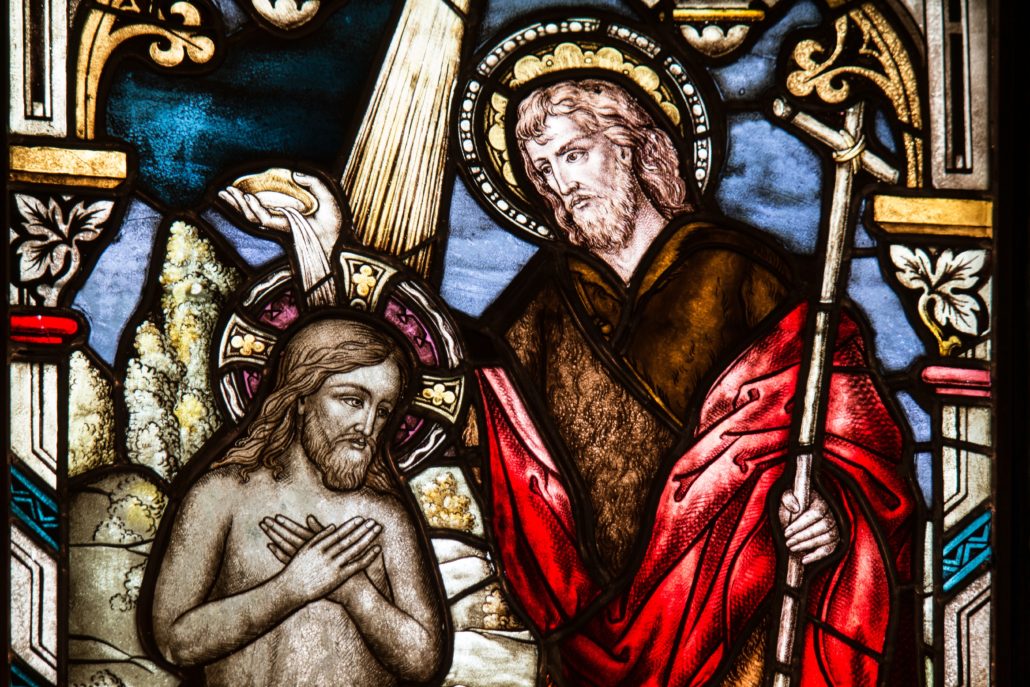
The real Jesus of the gospels is so much more compelling than the Jesus of the stained glass in the cathedrals. His words, his actions, and his ultimate sacrifice of love changed the world forever. A few billion people have found meaning in the real, jagged, challenging Jesus.
Live with the edginess. Let it hurt you. Let it wound you. Don’t settle for pearls.
The treasure you find will be greater by far.
[1] Matthew 5:37
[2] Matthew 10:34
[3] Matthew 26:6-13